Friday, July 21, 2023

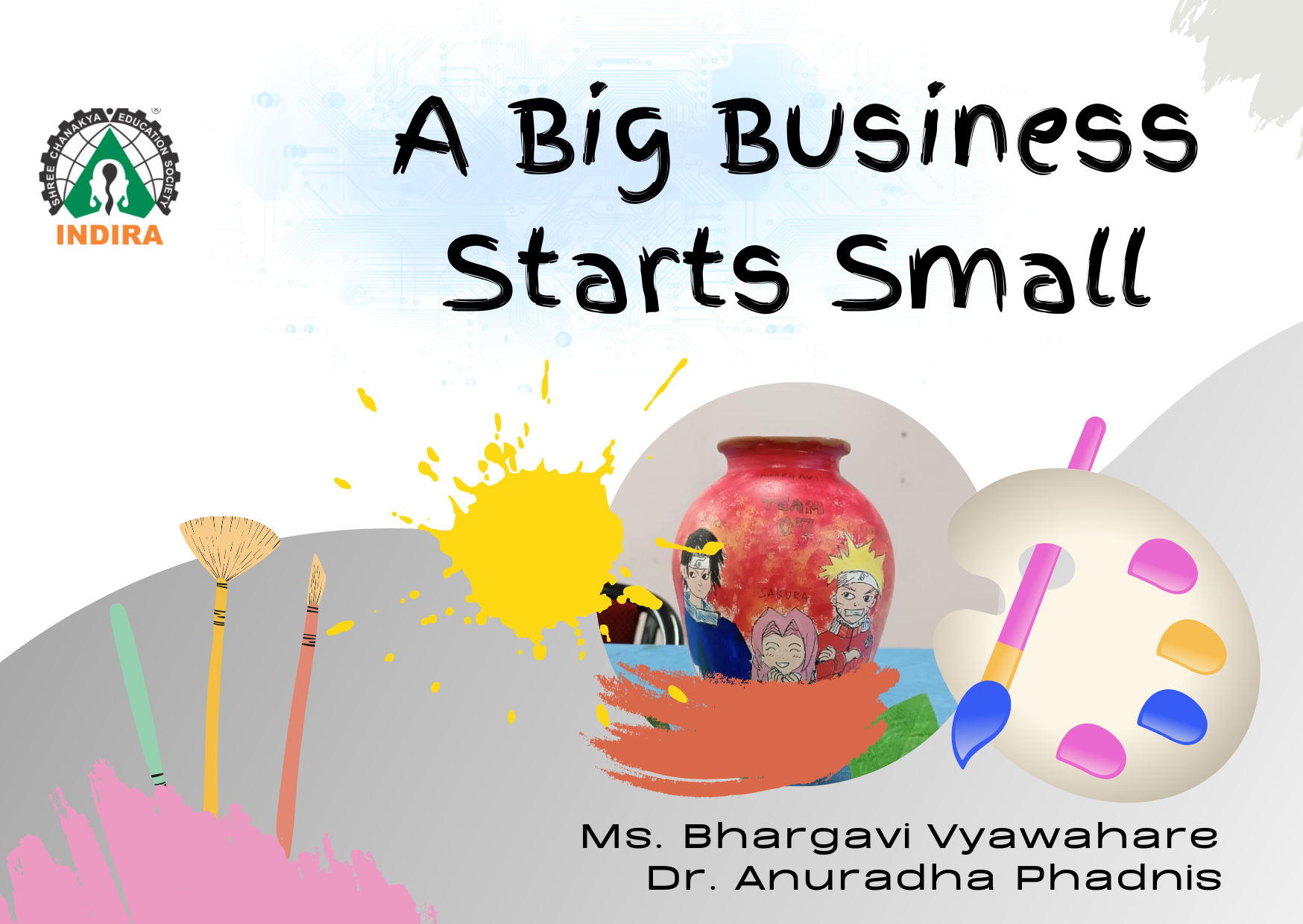
A Big Business Starts Small


………….lets walk that first Small Step

Entrepreneurships and Startups are becoming very popular in India. Startup India initiative intends to build a strong ecosystem that is conducive for the growth of startups. It aims to empower startups to achieve growth
through innovation and technology.

To promote growth and help Indian economy, many benefits are being given to entrepreneurs establishing startups. The startups recognised through the Startup India initiative are provided ample benefits for starting their own business in India.

There are various forms of start ups as Lifestyle Startups: Self-employed folks, Small Business Startups: Feeding the Family, Scalable Startups: Born to Be Big, Buyable Startups: Born to be bought, Large Company Startups: Innovate or die, Social Startups: Mission – Difference.

Tradition and Technology together are disrupting the entrepreneurial environment, Indian Culture and Crafts are picking up markets and attracting investors to leverage their scale. One such form ‘Amod’a Startup of Handmade Paintings (Ideation Stage) is canvased by a Management Student Ms.Bhagyashree Vyawahare, who wishes to convert her passion into profession is exhibited through this Blog.

“AMOD”….. Startup of Handmade Paintings (Ideation Stage)

Introduction:

“Amod” a startup business initiative in niche segment of art which focuses on preserving art culture specially in the paintings on canvas. Here specific type of handmade paintings to be created and sold viz; landscapes, portraits, abstract art, or any other style to be exceled in. Pre-study and analysis for such business is done in following areas.

Product Specifications:

Product Specifications:

a)      Art forms involved:

1)      Landscapes

2)      Portraits

3)      Abstract art

4)      Geometrical Paintings.

5)      Coffee Paintings.


Product Levels:


Level 1: Artworks

This represents the overall category of the product line, which is hand-painted canvas paintings.


Level 2: Painting Styles

Subcategory 1: Abstract Paintings

Subcategory 2: Landscape Paintings

Subcategory 3: Portrait Paintings

Subcategory 4: Still Life Paintings

Subcategory 5: Contemporary Paintings


Level 3: Painting Sizes

Subcategory 1: Small-Sized Paintings

Subcategory 2: Medium-Sized Paintings

Subcategory 3: Large-Sized Paintings

Subcategory 4: Custom-Sized Paintings


Level 4: Painting Themes

Subcategory 1: Nature and Wildlife Paintings

Subcategory 2: Cityscape Paintings

Subcategory 3: Floral Paintings

Subcategory 4: Seascape Paintings

Subcategory 5: Abstract Expressionism Paintings


Level 5: Painting Techniques

Subcategory 1: Oil Paintings

Subcategory 2: Acrylic Paintings

Subcategory 3: Watercolor Paintings

Subcategory 4: Mixed Media Paintings


Level 6: Special Collections

Subcategory 1: Seasonal Paintings

Subcategory 2: Limited Edition Paintings

Subcategory 3: Collaborative Artist Series.


Identified steps to start business in this sector are:

 Artists: It is one of the key resource in this form of startups. availability, their competencies, skills, creativity, flexibility, agility, technical skill, right environment to capture their creativity, is the essential part here.


Marketing and promotion: Create a marketing strategy to promote the handmade paintings. Utilize online advertising, content marketing, email marketing, and social media to showcase the artwork and build a loyal customer base. Consider collaborating with influencers, bloggers, or art critics to gain exposure.


Customer experience and after-sales: Provide excellent customer service to ensure customer satisfaction. Safely package and ship the paintings to prevent damage. Offer a return policy, and consider providing certificates of authenticity or limited editions for higher-value pieces.


Expand the offerings: Once the business gains traction, consider expanding the offerings. You could introduce prints or merchandise featuring your artwork, offer commissioned paintings, or collaborate with other artists for joint projects.


Continuous learning and improvement: Stay updated with the latest trends and techniques in the art industry. Attend workshops, exhibitions, and art events to enhance the skills and network with fellow artists. Adapt the business strategy based on customer feedback and market trends.


Marketing Techniques:

·         Strong online presence (Digital Marketing)

·         Participate in art exhibitions and fairs

·         Email marketing

·         Online advertising

·         Collaboration with charities or non-profit organizations.

·         Customer engagement and referrals


Managing Finances by raising funds from various sources.

 Some of them are:

1.      Pradhan Mantri Mudra Yojana

2.      Credit Guarantee Trust Fund for Micro and Small Enterprise (CGTSME)

3.      Financial Support to MSMEs in ZED Certification.

4.      Credit Linked Capital Subsidy for Technology Upgradation (CLCSS).

5.      Design Clinic for Design Expertise to MSME.


Blog by Ms.Bhargavi Vyawahare

Bhargavi.Vyawahare@indiragbs.edu.in

Mentored by Dr,Anuradha Phadnis

Anuradha.Phadnis@indiragbs.edu.in

SCES, Indira Global Business School


Friday, July 14, 2023

Fintech – Revolutionizing the Future of Finance


Due to technology breakthroughs and innovation, the Finance or Financial industry is going through a seismic transformation. The future of MBA Finance transform into Fintech in this paradigm shift.  Transitioning from an MBA in Finance to a career in Fintech can be a great move considering the rapid growth and innovation happening in the financial technology industry. The term "Fintech," which stands for "Financial Technology," has become a disruptive force, reshaping conventional Financial systems and creating new opportunities for both people and companies. In this article, we examine how Fintech can change the Finance or Financial landscape and what it means for the Financial management aspirants and the industry.


Fintech is a new technology that aims to automate and enhance the financial services industry in terms of simplicity, speed, reach, and accuracy. Fintech, is being utilized in practically every facet of the financial services industry Businesses revolutionizing customer-facing business processes.

Financial Inclusion Enhanced:

Fintech has the ability to close the financial services gap for underbanked or unbanked people. Fintech solutions give those who were previously excluded access to financial services through mobile banking, digital wallets, and online payment systems and the business endeavors is made possible by this expansion in financial inclusion.

Streamlined Digital Payments:

With their simplicity and speed, contactless payments Digital payment solutions are displacing traditional payment systems as they are more effective and secure. Blockchain technology, which enables secure and transparent transactions, lowers fraud, and eliminates middlemen, has also been implemented by fintech.

Disrupting Traditional Banking:

Fintech has challenged the monopoly of existing financial institutions by upending the traditional banking industry. Customers can now access financial services through neobanks, or digital-only banks without actual branches, using user-friendly smartphone apps. The personalized financial solutions, reduced costs, and improved client experiences provided by these digital banks force traditional banks to change and advance in order to remain competitive.

Empowering Personal Finance:

Fintech is empowering individuals to take control of their personal finances through various tools and applications. Budgeting apps help users track their expenses, set financial goals making wealth management more accessible to the masses.

Data-driven Insights and Risk Assessment:

Robo-advisors use algorithms to offer automated investing advice, making wealth management more accessible to the masses. Additionally, crowdfunding platforms let users raise money for endeavors or projects from the general public directly instead of going through conventional financial institutions.

Fintech Landscape

Fintech startups have received cumulative funding of several billions of dollars. CB Insights estimates that the global valuation of 26 Fintech unicorns is more than $150 billion. North America produces the majority of financial startups, Asia being the second.

Some of the most active Fintech innovation sectors


  • The concept of "open banking", which makes use of Blockchain, enables third parties to have access to bank data in order to develop applications that will connect a network. An instance of the same is the "Mint" all-in-one financial management programme.
  • Blockchain incorporates the digital currency Ethereum, a type of distributed ledger technology (DLT) that uses no central ledger and keeps records on a computer network.
  • Digital funds and crypto currencies,"Robo-advisors" automated investment advice,"Regtech," assisting businesses in offering financial services in order to comply with industry regulations, "Insurtech” simplify and streamline the insurance industry's operations.

Conclusion:

Fintech is transforming the financial industry by providing creative solutions, better access to financial services, and improved client experiences. The users of Fintech are broadly Business to Business for banks, their business clients, Business to Consumers for small business firms, Consumers. Hence Finance Aspirants may build out an exciting and fulfilling career in this rapidly growing industry by fusing their knowledge of finance with the innovation and revolution taking place in the Fintech space.

Fintech's transformative power resides in its capacity to democratize financing, empowering individuals, educating management scholars, entrepreneurs, and employees by offering useful and efficient tools to manage their financial life without having any psychological prejudices. Huge data availability, powerful analytics tools and approaches, rising interest in mobile banking, and many other supportive variables will lead to increased business opportunities. COVID-19, has already accelerated its reach. As technology develops, Fintech will become crucial lifeline of financial future.

Blog By


Dr. Priya Tiwari

Mail- Priya.Tiwari@indiragbs.edu.in

Indira Global Business School, Pune


Tuesday, July 4, 2023

Gain an Edge while pursuing MBA: Learn a Foreign Language


 The world is becoming a smaller place by the day. Since 1991, India made Liberalisation, Privatisation and Globalisation reforms, the Indian economy has transformed, the commerce and trade have opened up in a very big way.   Along with multinational companies, even small and medium-scale enterprises are striving hard to make a global presence. With the government of India’s Ministry of Micro, Small and Medium Enterprises doing its best to put the MSME’s on the global map, being in line with the efforts and advancements is extremely necessary.


We all are aspiring employees or entrepreneurs who would want to have their presence felt in the global workspace. What can be done to at least have a shot at actually realising that dream?????

Along with formal education, in our case MBA… we also need to have additional qualifications to gain an edge….

One of the ways to do so is learning a foreign language……..

Now let’s talk of some benefits of learning a foreign language….

         Learning a foreign language is intriguing: With its warmth and voluptuous sounds, hearing someone speaking a foreign language is like the sound of gold coming to embrace you. Speaking a foreign language is incredibly alluring and it can make you more attractive, interesting, and gives you an air of intelligence. A lot of people find a certain language or accent to be really appealing —think Penélope Cruz’s Spanish or Monica Bellucci’s Italian—you get the picture.  Learn a foreign language and you might just have that certain someone hypnotized and drawn to your exotic prowess. The rich textures of almost any foreign language can be incredibly interesting


          Learning a foreign language opens up a world of job opportunities: With globalization in full swing, there’s a good chance you’ll be working with people whose first language isn’t English. Maybe it’s a development team in India, or a manufacturing plant in China, or an alternative energy supplier in Germany. Being able to communicate in other languages makes you much more valuable to an employer and having that competitive edge on your resume is without a doubt an eye-catcher.

·         Studying a foreign language is good for the brain:  Studies have demonstrated the cognitive benefits of learning another language, no matter how old you are. These studies have shown that bilinguals tend to have bigger brains, better memories, are more creative, better problem solvers, etc. Not only do these advantages make it easier to learn yet more languages, they also make it easier to learn, well, anything. The ability to quickly switch between tasks is especially important in today’s busy multitasking world. Bilinguals can switch between tasks much faster than their monolingual counterparts and can handle many more tasks at once.  


·     
   
Studying a foreign language makes you more open minded: Foreign language study is simply part of a very basic liberal education. To educate is to lead out—to lead out of confinement and narrowness and darkness. Learning a foreign language and getting soaked into an entirely new culture and worldview is the surest way to become an open-minded, understanding, tolerant individual, and that is absolutely priceless. Once you are aware of the fact that we are all cultural beings, products of our own environments, and that you recognize the cultural base for your own attitudes and behaviour, you are ready to consider others in a more favourable light. Seeing the world from a different perspective, and understanding where you and others come from, is a fantastic, eye-opening experience.

          Learning a foreign language is of the utmost importance and the reasons to study a foreign language are innumerable. Studying (and ultimately fluently speaking) a foreign language helps break barriers and connects human beings on a deeper level of mutual understanding. Plus, reaching this mutual understanding will inevitably open a series of doors leading to a more interesting and satisfying personal and professional life!

 Last but not the least… Remember, while learning a foreign language can indeed provide a competitive advantage, it's also important to develop other skills relevant to your desired field or industry. A well-rounded skill set, combined with language proficiency, can greatly enhance your employment prospects.


Enjoy !!!!!!!!!!!!


Prof.  Girija Shirurkar.

Girija.Shirurkar@indiragbs.edu.in.

Indira Global Business School, Pune.


Tuesday, June 27, 2023

Navigating the Future: Exploring the National Logistics Policy 2022


Prof. Pranita Bhujbal

 Prime Minister Narendra Modi launched the National Logistics Policy (NLP) on 17th September 2022 in Vigyan Bhawan, New Delhi. This policy will create a single window e-logistics market and put an emphasis on developing skills, competitiveness, and employment for MSME’s. National logistics policy is the next logical step of PM GAtiShakti National Master Plan (NMP).

Department for promotion of industry and internal trade, Ministry of commerce & industry, Government of India has defined vision of NLP, “To develop a technologically enabled, integrated, cost-efficient, resilient, sustainable and trusted logistics ecosystem in the country for accelerated and inclusive growth.”

Well-structured logistics sector forms the backbone of trade in any country. Indian logistics market is worth over $200 billion as per government estimates. Irony is this sector is still extremely complicated and inefficient. NLP has set target to reduce the logistics cost from present 14% of GDP to less than 10% by 2022. National Logistics Policy will improve India’s trade competitiveness, create more jobs, improve India’s performance in global rankings and pave the path for India to become a logistics hub.

Three main targets set by NLP are: 1. Reduce cost of logistics in India to be comparable to global benchmarks by 2030. 2.Logistics Performance Index ranking- endeavor to be among top 25 countries by 2030, and 3. Create data driven decision support mechanism for an efficient logistics ecosystem.

NLP will be implemented through a comprehensive logistics action plan (CLAP), this is divided into eight key action areas. These areas are, Integrated Digital Logistics Systems, Standardization of physical assets & benchmarking service quality standards, Logistics Human Resources Development and Capacity Building, State Engagement, EXIM (Export-Import) Logistics, Service Improvement framework, Sectoral plan for efficient logistics, Facilitation of development of logistics parks.   

The Government of India has prioritised developing a robust and cost-efficient logistics ecosystem. To fulfil this vision, the logistics division of DPIIT, Ministry of Commerce & Industry undertakes an annual “Logistics Ease Across Different States (LEADS)” survey in all States/ UTs to assess and suggest various improvements in logistics sector of the country.

Four features are integrated in NLP, Integration of Digital System (IDS), Unified Logistics Interface Platform (ULIP), Ease of Logistics (ELOG), and System Improvement Group (SIG). The NLP can bring about positive changes in supply chain management, including improved efficiency, better infrastructure, technology adoption, streamlined regulations, skilled workforce, and sustainable practices. It presents opportunities for supply chain managers to enhance their operations, reduce costs, and improve overall supply chain performance. long-term implications of the NLP on the logistics industry include industry growth, technological advancement, improved supply chain visibility, sustainability practices, skilled workforce development, and enhanced cross-border collaboration. These implications contribute to the long-term evolution and transformation of the logistics industry, making it more efficient, competitive, and sustainable.

The NLP's emphasis on technology adoption and digitalization is likely to drive a significant digital transformation in the logistics industry. Technologies such as artificial intelligence (AI), machine learning (ML), Internet of Things (IoT), and block chain will become more prevalent. Logistics companies will increasingly leverage these technologies to automate processes, improve efficiency, and enhance supply chain visibility. With the NLP promoting the use of advanced analytics and data management, logistics companies will have access to a wealth of data. This will enable them to make data-driven decisions, optimize operations, and identify areas for improvement. Predictive analytics and real-time data monitoring will become common practices, facilitating proactive decision-making and risk management. The emphasis on collaboration among stakeholders will drive increased collaboration and integration within the logistics ecosystem. Supply chain partners, including manufacturers, suppliers, logistics service providers, and customers, will work together more closely to optimize processes, share resources, and achieve greater supply chain efficiency. This collaboration may extend to the development of shared logistics infrastructure and joint initiatives. The NLP's focus on optimizing logistics processes and improving connectivity is likely to drive innovation in last-mile delivery. Companies will explore new delivery models, such as drone delivery, autonomous vehicles, and crowd shipping. The integration of technology, data analytics, and real-time tracking will enable more efficient and customer-centric last-mile logistics operations.  With the NLP promoting skill development programs, the logistics industry will witness a shift in talent management practices. There will be an increased focus on attracting and developing skilled professionals who can leverage technology, drive innovation, and adapt to changing industry requirements. Training programs and partnerships between industry and educational institutions will become more prevalent. NLPs that prioritize cross-border logistics and trade facilitation will drive increased efficiency and integration in international supply chains. This will lead to the growth of cross-border e-commerce, improved customs processes, and enhanced connectivity between countries. Logistics companies will focus on building robust global logistics networks to support the smooth flow of goods across borders.


Prof. Pranita Bhujbal

Email- Pranita.Bhujbal@indiragbs.edu.in

Monday, June 5, 2023

World Environment Day: Raising Awareness and Taking Action for a Greener Future


-Khan Naikwadi Sehrish Feroz

World Environment Day, celebrated annually on June 5th, serves as a global reminder of the pressing environmental issues we face and the urgent need to address them. This significant event aims to increase public understanding and encourage action to protect our environment for a sustainable future. With various themes each year, World Environment Day highlights the multifaceted nature of environmental problems and the collective effort required to tackle them. In this comprehensive article, we will delve into the history, significance, and ways to celebrate World Environment Day, as well as discuss the impact of fast fashion and India's specific environmental challenges.

World Environment Day 2023: Theme

Each year, a unique theme is selected for World Environment Day to draw attention to specific aspects of environmental problems. The theme for World Environment Day 2023 is "Beat Plastic Pollution." This theme emphasizes the detrimental effects of plastic on our environment and urges individuals to seek alternatives to reduce plastic usage.

The Importance of Tackling Plastic Pollution

Plastic pollution poses a significant threat to our environment due to its non-biodegradable nature, causing long-lasting harm to ecosystems, wildlife, and human health. By focusing on the issue of plastic pollution, the theme for World Environment Day 2023 encourages individuals, communities, and industries to find innovative solutions to combat this global problem and transition towards a more sustainable and eco-friendly lifestyle.

World Environment Day: History and Significance

The United Nations General Assembly introduced World Environment Day in 1972 during the Stockholm Conference on Human Environment. This conference discussed the establishment of international measures to address the growing concern of environmental issues. The first celebration of World Environment Day took place in 1974, and since then, it has become a crucial annual event, bringing attention to the importance of environmental preservation and sustainable development.

The Role of World Environment Day

World Environment Day plays a vital role in raising awareness about environmental problems and inspiring individuals, communities, and governments to take steps towards a greener future. The event also serves as a platform for sharing innovative solutions and best practices to address global environmental challenges. By engaging people from all walks of life, World Environment Day promotes the idea that everyone has a role to play in protecting our planet and making sure of a sustainable future. World Environment Day serves as an essential reminder of our responsibility to protect the environment and strive for a more sustainable future. By raising awareness about pressing environmental issues, such as plastic pollution and fast fashion, and promoting collective action, this event encourages individuals, communities, and governments worldwide to work together to overcome these challenges. As we celebrate World Environment Day 2023, let us commit to making a positive impact on our planet and providing a healthier, greener future for generations to come

India's Theme for World Environment Day 2023: "Preserving Biodiversity: Sustaining Life, Nurturing Future"


The choice of India's theme for World Environment Day 2023, "Preserving Biodiversity: Sustaining Life, Nurturing Future," reflects the nation's commitment to raising awareness about the importance of biodiversity conservation and inspiring collective action. The theme emphasizes the interdependence between biodiversity and human well-being, emphasizing the need to preserve ecosystems for ‌present and future generations.


World Environment Day, celebrated annually on June 5th, is a global initiative by the United Nations (UN) to raise awareness and encourage action for the protection and preservation of the environment. Each year, a different country is chosen to host the event and set the theme. In 2023, India has been bestowed with the honor of hosting World Environment Day, and the nation has chosen the theme "Preserving Biodiversity: Sustaining Life, Nurturing Future" to highlight the significance of safeguarding biodiversity for the well-being of present and future generations.

 Biodiversity: The Essence of Life:

 Biodiversity, or biological diversity, refers to the variety of living organisms present on Earth. It encompasses the incredible array of species, ecosystems, and genetic diversity that coexist and interact with one another. Biodiversity plays a vital role in maintaining the balance of our planet's ecosystems and provides numerous ecosystem services essential for human survival and well-being.

 India's Rich Biodiversity:

 India is renowned for its rich biodiversity, ranking among the world's top ten mega-diverse countries. Its vast geographical and climatic diversity, spanning from the icy Himalayas to the tropical rainforests, supports an astonishing range of ecosystems and species. India is home to diverse habitats, such as forests, grasslands, wetlands, coastal areas, and deserts, harboring numerous endemic and endangered species.

 Challenges to Biodiversity in India:

 Despite its remarkable biodiversity, India faces several challenges that threaten its ecological balance. Rapid urbanization, industrialization, population growth, and unsustainable development practices have led to habitat destruction, fragmentation, and loss of biodiversity. Deforestation, pollution, invasive species, climate change, and poaching further exacerbate the problem, pushing several species towards the brink of extinction.

 The Importance of Preserving Biodiversity:


 Preserving biodiversity is crucial for numerous reasons. Firstly, biodiversity contributes to the stability and resilience of ecosystems, enabling them to withstand environmental changes and disturbances. It enhances ecosystem productivity, nutrient cycling, soil fertility, and water purification, benefiting human livelihoods and agriculture. Biodiversity also provides sources of food, medicine, raw materials, and cultural values that are deeply intertwined with human societies.


India's Initiatives for Biodiversity Conservation:

 Recognizing the urgent need to preserve biodiversity, India has implemented various initiatives and policies to address the challenges. The country has established a network of national parks, wildlife sanctuaries, and biosphere reserves to protect and conserve critical habitats and species. The Wildlife Protection Act and Forest Conservation Act provide legal frameworks for wildlife conservation and forest management.

 India has also launched flagship programs like the National Biodiversity Action Plan, National Mission for Sustainable Agriculture, and National Afforestation Program to promote sustainable land use, biodiversity conservation, and ecosystem restoration. The government has actively engaged local communities, indigenous tribes, and stakeholders in conservation efforts, recognizing their crucial role as custodians of biodiversity.

  Objectives and Activities:

 India aims to use World Environment Day 2023 as a platform to highlight the threats facing biodiversity; showcase successful conservation initiatives, and mobilize individuals, communities, and governments towards biodiversity conservation. The following activities are planned to achieve these objectives:

 Awareness

Awareness Campaigns: Extensive awareness campaigns will be conducted across the country, targeting schools, colleges, communities, and various stakeholders. The campaigns will raise awareness about the value of biodiversity, the threats it faces, and the importance of conservation efforts.

 Conservation Exhibitions: Exhibitions and events will be organized to showcase India's rich biodiversity and highlight successful conservation projects. These exhibitions will provide a platform for knowledge exchange and promote sustainable practices and innovations.

 Community Engagements: Communities living near critical biodiversity hotspots will be engaged through interactive sessions, workshops, and capacity-building programs. Their traditional knowledge and practices will be recognized and integrated into conservation strategies, making sure of their active participation and empowerment

 Policy Dialog: High-level policy dialogs and conferences will be held to discuss the challenges and opportunities related to biodiversity conservation. Experts, policymakers, scientists, and stakeholders will come together to develop strategies and policies that promote sustainable development while safeguarding biodiversity.

 Conservation Initiatives: On-ground conservation initiatives, such as tree plantations, habitat restoration, and wildlife protection activities, will be undertaken across different regions of the country. These initiatives will involve collaboration between government agencies, NGOs, and local communities.

 India's theme for World Environment Day 2023, "Preserving Biodiversity: Sustaining Life, Nurturing Future," underscores the urgent need to protect and conserve biodiversity for the well-being of present and future generations. Through this theme, India aims to raise awareness, mobilize action, and showcase successful initiatives in biodiversity conservation. By recognizing the value of biodiversity and engaging communities and stakeholders, India hopes to inspire a collective effort toward preserving the incredible diversity of life on our planet. Only by safeguarding biodiversity can we provide a sustainable and thriving future for all.


Blog By: Khan Naikwadi Sehrish Feroz


MBA Ist Year 
Email- sehrish.khannaikwadi@indiragbs.edu.in.
Friday, November 4, 2022

Marketing Strategy: Decoding Consumer Behaviour.


“Failure is only the opportunity to begin again, this time more intelligently.”

–Henry Ford

After World War II, the clouds of war started to fade with each sunrise. Along with that, the economy of Japan began to flourish again. The reason behind the acceleration of the Japanese economy was the effective allocation of resources - the workforce of Japan shifted to the non-agriculture sector from the agriculture sector. As a result, the per capita income of Japan postwar rose at a 7.1% average annual growth rate.

Nescafe was the leading coffee brand of Nestle in the global coffee market and thought this would be the right time to enter the growing economy of Japan. It wasn't a secret that tea was part of Japanese culture. Nescafe thought it would be easy to replace tea with coffee to penetrate the Japanese market. They observed the Japanese consumer cautiously and carried out many focus groups to analyze the taste and preferences of Japanese consumers. As anticipated, all market research was in the favor of Nescafe, and almost all volunteers of the focus group loved the taste of coffee. Nescafe was all set to dominate the beverage market by investing a huge amount in the advertisement of the coffee brand. They shifted to the top gear and executed a rollout plan to have their coffee on each shelf in Japan at an affordable cost.

However, the result was disappointing marketers of Nestle failed to acquire Japanese consumers. Though the market research showed positive signs and the Japanese consumer loved the taste of coffee, Nestle Coffee wasn't selling in Japan. Nestle became eager to know why Japanese consumers stuck with the cup of tea. This time Nestle appointed Dr. Clotaire Rapaille to dig to the root of the problem.

Gilbert Clotaire Rapaille, a French marketing consultant had expertise in dealing with intricate marketing problems. He approached this problem with his way of doing things. Clotaire believed that the desires that drove humans were unconscious ones, and only a very few were aware enough to understand them. He called this reptilian instinct. Clotaire interviewed consumers and asked them about their

previous association of them with coffee. Surprisingly, they hadn't any childhood memory associated with coffee. Japanese kids grew up with the smell of tea and watching their parent drink tea. No wonder the Japanese chose tea over coffee as they had cultural imprints of the tea, and those imprints come with emotions.

Clotaire reached out to the brand managers with the suggestion to stop wasting money on marketing the brand as the problem was much deeper. When you first comprehend a word, you imprint its meaning on your mind and establish a mental association that will last the rest of your life. And you need some emotions to form this mental link. Neurotransmitters cannot be produced in the brain without emotion, hence a connection cannot be made. So, each word has a mental highway. In the case of Japanese consumers, the emotional link for coffee was missing.

This time Nestle rolled out coffee candies in the Japanese market to create imprints of coffee. Japanese kids started liking the taste of coffee candies and it became part of their childhood memory. Nestle cleverly moved them from candy to cold sugary coffee-flavored drinks and after that, they followed the generations. A decade later, Nestle entered the market again with the same energy. And before Japanese consumers knew their reptilian instinct chose a steamy mug of Nescafe coffee over tea. For the Japanese working class, black coffee became the reason for the short breaks between the long office hours. Furthermore, canned coffee that was distributed through vending machines became popular among the younger population.

The patience and perseverance of Nestle to understand its consumers paid off. In 2020, according to Knowledge Sourcing Intelligence’s report, the instant coffee market in japan was valued at USD 3.19 billion and expected to grow at a CAGR of 3.85% to USD 4.15 billion in 2027. Nescafe is one of the key market players in Japan.

This case study delivered by Dr. Clotaire Rapaille was an ideal example for marketers to learn the correlation between the consumer's cultural imprints and consumer preferences and their buying behavior patterns. A smart marketer should not limit his market research to the word of consumers. Consumers never buy anything unknowingly, there is some psyche behind their purchase, and sometimes they may fail to put it into words. To market their product better, marketers should understand the psychology of consumers beyond words.

Blog By:

Blog By:
Jayesh Kangare
MBA II Year 2021-23
Mail- Jayesh.Kangare@indiragbs.edu.in


Dr.Aaatish Zagade
Dy. Director
Indira Global Business School, Pune.
Mail- aatish.zagade@indiragbs.edu.in.


Monday, August 15, 2022

Next Gen Supply Chains


   Delivering promises and adding delighted customers to your business network is the underlined requirement of today’s cut-through competitive era. Every company wants to meet its delivery deadlines and quarterly goals, and an efficient supply chain can be a valuable investment towards that end.  

Supply chains around the world are struggling to serve the surging demand, post pandemic impact includes labor shortage, lack of raw materials and key components. Next generation supply chains handle these issues with IOT.  Management, forecasting, and oversight applications help fleet managers to improve efficiency in processing and add transparency to decision making. It is a growing practice nowadays even for small business. 


 There are many reasons for using IoT in supply chains. Like real- time location tracking can be done with the help of IoT, it provides decision makers with real time data regarding the location of the product and transportation environment. Alerts can be sent when the product is shipped in the wrong direction, also monitoring delivery of ready goods and raw materials is possible. IoT supply chain solutions gather data about temperature inside the vehicle or warehouse, pressure, humidity that could impact the product’s integrity and trigger automatic condition adjustment. With the help of real time tracking, companies can monitor goods during shipment and predict the delivery as well as forecast and mitigate risks associated with delays. These trackers are also used in warehouse automation with little or no human supervision. 

Forecasting plays a key role in decision making, thanks to IoT and data analytics, helping supply chain managers plan routes with the visibility to, traffic alert, weather, accidents, or other delay-including occurrences.  

Significance of IoT in supply chain: If you are still wondering how IoT can improve supply chain efficiency, here is your answer.  

When you build your supply chain with machine learning, you can reduce logistics and transportation costs with shipping routes that maximize flexibility in case of an emergency. It provides predictive maintenance and repair schedules for valuable equipment. Real-time decision-making prevents geographic supply shortage-based on data from multiple systems. Data analytics helps with handling massive data efficiently, this data if compiled can provide effective machine learning models. 

Machine learning provides real time visibility of organization, delivery network, inventory management, it helps process massive amounts of data and distill it. This level of visibility enables the organization to respond to changes quickly and share real-time information with supply chain vendors, partners, and customers.  


As IoT is still an emerging technology some challenges are yet to be overcome. Most supply chains are universal, and it is not secure to accept what’s accessible and how things work in your domestic geology and how your products travel. Those gaps within the organizations can make a part of issues when the rest of your frameworks are depending on steady streams of information all through the supply chain. We know that the complexity for execution happens within the IoT environment since the IoT gadgets are connected to multiple points, such as endpoint gadgets, mobile applications, and cloud platforms. Industries focus on cutting costs, but IOT gadgets are not affordable. They have a high price and when it comes to maintenance it needs monthly maintenance too.  

IoT offers a cognitive system that learns from and infuses intelligence into the physical supply chain world to ensure product reliability and even save lives. The future success of companies in industries are indeed heavily dependent on digitized real time supply chains. 

A promising future will make a variety of advanced technologies universally accessible, such as: Assessing manufactured products for defects or damage, verifying product authenticity at every stage of the supply chain, providing shareable visibility across supply chain networks for both commercial entities and consumers, building smart warehouses with efficient inventory management, Reducing supply chain costs, product and raw material waste and transport congestion.  

The age of intelligence has arrived, and surviving disruption will require creating it. 

References:https://www.blumeglobal.com/learning/internet-of-things/https://www.digi.com/blog/post/iot-supply-chainhttps://ubidots.com/blog/iot-supply-chain-management/https://www.digiteum.com/iot-supply-chain/

Blog by:


Mr. Amit Narayane

MBA First Year.

Email: amit.narayane@indiragbs.edu.in


 Prof. Pranita Bhujbal

Assistant Professor,

Indira Global Business School, Pune

Email: Pranita.bhujbal@indiragbs.edu.in


Artificial Intelligence and Relevance of Management Education in Changing Business Environment

  Technology has transformed our lives and Artificial Intelligence (AI) is a groundbreaking advancement that is reshaping industries and wor...